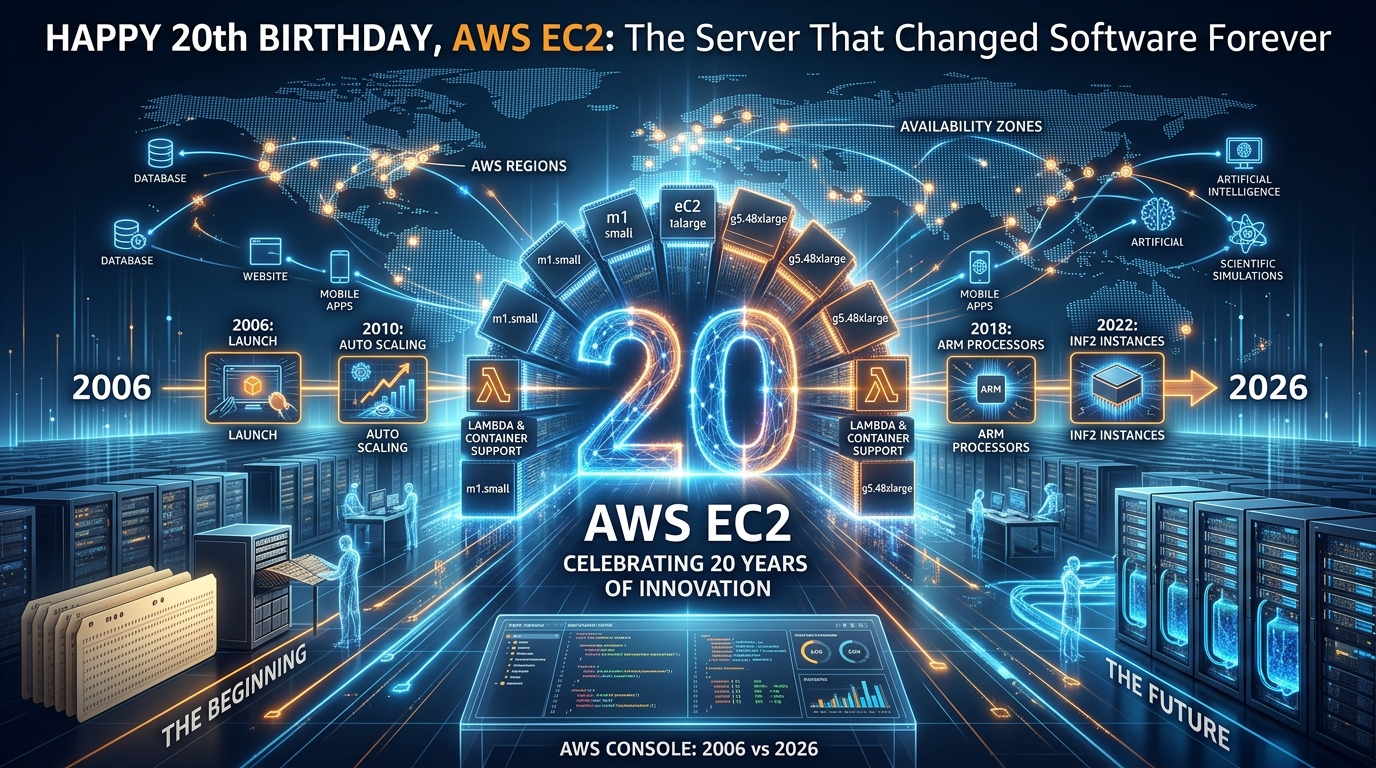
On August 25, 2006, Amazon opened a public beta to a service with a price tag so modest it barely registered as news: rent a Linux server by the hour for ten cents. No contracts. No rack space to procure. No hardware to deprecate. Just compute, on demand, billed to the minute. That service — AWS Elastic Compute Cloud — turns twenty years old this month, and it is difficult to overstate what those twenty years have meant for everyone who builds software for a living.
EC2 did not invent cloud computing. The term predates the service by years, and vendors had been selling virtualized hosting long before Amazon entered the space. What EC2 did was something more consequential: it industrialized the model, priced it aggressively, and made it genuinely programmable — so that the same API call that provisioned a server for a side project could scale, without modification, to provision ten thousand servers for a Super Bowl broadcast. That combination of simplicity, programmability, and elastic economics is what rewired the industry.
This piece is not a feature comparison or a deployment tutorial. It is a practitioner's retrospective — two decades of watching EC2 evolve from a single instance type in one US region into the infrastructure layer underneath a meaningful fraction of the internet.
Key Takeaways
- EC2 launched in public beta on August 25, 2006 with a single instance size (m1.small at $0.10/hr for Linux) serving a single US East region.
- Twenty years later, EC2 spans 39 AWS regions with more than 1,200 instance types across x86, Arm, GPU, and custom ML silicon families.
- AWS holds approximately 29% of the global cloud infrastructure market — a position built on the first-mover advantage EC2 established (Synergy Research Group, Q3 2025).
- The Nitro hypervisor (2017) and the Graviton ARM processor line (2018–2024) represent the two biggest architectural leaps, enabling near bare-metal performance at cloud economics.
- Companies like Netflix, Airbnb, and Dropbox used EC2 to scale without capital expenditure — and established the "build on cloud first" model that every VC-backed startup has followed since.
The World Before EC2
To understand what EC2 disrupted, you have to remember what infrastructure procurement looked like in 2006. If you were building a web application and expecting significant traffic, you had two realistic options: co-locate servers in a data center, or rent dedicated hardware from a hosting provider. Both paths involved lead times measured in weeks. You filled out purchase orders, waited for hardware to arrive, racked and cabled it, installed an OS, and then hoped you had provisioned enough capacity for your peak load — because if you hadn't, ordering more took the same weeks-long process again.
The asymmetry was brutal for startups. You either over-provisioned (paying for idle capacity you might never use) or under-provisioned (and watched your service crumble the first time you got significant traffic). Capital expenditure was the price of admission, and that price excluded most people who had ideas but not runway.
AWS had already begun addressing the storage side of this problem. Amazon S3 launched on March 14, 2006, and proved that developers would pay for elastic, API-driven infrastructure by the unit of consumption rather than by the machine. EC2 applied the same logic to compute — and the combination of S3 and EC2 gave engineers the first real alternative to owning their own hardware.
The Beta That Changed Everything
The EC2 public beta launched with three Linux instance sizes: the m1.small (1 ECU, 1.75 GB RAM) at $0.10/hr, the m1.large (4 ECU, 7.5 GB RAM) at $0.40/hr, and the m1.xlarge (8 ECU, 15 GB RAM) at $0.80/hr. One region — US East (N. Virginia). No persistent storage beyond the instance's own ephemeral disk. No Virtual Private Cloud, no placement groups, no Elastic Load Balancer. Just raw virtual machines, booted from Amazon Machine Images, billed by the hour.
The pricing model itself was the innovation. Not because the prices were low — co-location could sometimes be cheaper on a per-CPU basis — but because the unit of purchase was radically small. An hour. Not a year's contract, not a three-year amortization schedule. One hour, and you could walk away. That granularity meant that the correct answer to "how much compute do I need?" changed from a capital planning question to an operational one. You could be wrong and recover in minutes instead of months.
The project that became EC2 did not begin in Seattle. Amazon opened an engineering office in Cape Town, South Africa in December 2004, assigning a team of 14 engineers led by Chris Pinkham and Willem van Biljon to build the idea out. The project's internal working name was the "Amazon Execution Engine." In the earliest prototyping days, the team used a stack of laptops to simulate server rack infrastructure because the actual hardware had not yet been ordered.
Jeff Barr, AWS's chief evangelist, wrote the EC2 beta launch blog post not from Amazon headquarters but from a poolside lounge chair in Cabo San Lucas, Mexico, shielding his laptop screen from the sun under a towel. He spent the rest of that vacation offline, unaware of the developer excitement building around the announcement. The understated tone of that launch post — a few hundred words, a price list, an invitation to apply for access — set a template for AWS communications that persisted for years.
Early adopters moved fast. By the time EC2 reached general availability in October 2008, a new playbook had emerged in Silicon Valley: validate your idea on EC2, scale it on EC2, and only revisit the infrastructure model if the economics at massive scale made a compelling case for something different. For most companies, the compelling case never materialized.
Milestones: Two Decades of EC2
No two-decade technology story compresses neatly into a list. But EC2's trajectory from a beta experiment to a global infrastructure platform can be traced through the moments where its capabilities changed qualitatively — not just grew quantitatively. Here are the moments that defined the platform.
EC2 Today: The Numbers
Scale in cloud computing is hard to make concrete because the numbers are large enough to lose their shape. Here is an attempt.
AWS operates more than 39 launched regions and 105 availability zones as of 2026 — up from a single region with two availability zones at EC2's launch. Each availability zone is a physically separate data center cluster with independent power and cooling, connected to its peers in the same region by low-latency private fiber. The geographic distribution means that a service deployed across multiple regions can survive the complete failure of an entire region — a failure mode that, in 2006, would have meant renting new hardware in a different geography over the course of weeks.
The instance catalog has grown from three sizes to more than 1,200 distinct instance types spanning x86 processors from Intel and AMD, AWS's own Graviton Arm processors, and purpose-built ML silicon including Trainium and Inferentia. Processor families now include options optimized for compute, memory, storage I/O, networking throughput, GPU acceleration for graphics and ML, and HPC workloads. The selection problem has, if anything, overshot — choosing an instance type is now a meaningful engineering decision with performance and cost implications that require benchmarking rather than intuition.
AWS holds approximately 29% of the global cloud infrastructure market as of Q3 2025, according to Synergy Research Group, with Microsoft Azure at roughly 20% and Google Cloud at 13%. The gap at the top — AWS versus its nearest competitor — is a direct artifact of EC2's head start. AWS had four years of production-hardened infrastructure, an established ecosystem of tools and instance types, and a customer base trained to think in AWS primitives before Azure's IaaS offering had reached comparable maturity. That lead compounds: customers who standardized on EC2 in 2008 built institutional knowledge, internal tooling, and hiring pipelines around AWS that are non-trivial to migrate away from.
The Companies That Made Their Name on EC2
The modern internet's most recognized names have EC2 in their infrastructure history in ways that were not inevitable — they were choices made under conditions of uncertainty, and those choices worked.
Netflix is the canonical story. After a 2008 database corruption incident that disrupted DVD shipments, the streaming service began its migration to AWS — a move that, at the time, struck many infrastructure professionals as either brave or reckless. By January 2016, Netflix had completed the migration of its entire streaming service to AWS (Netflix Tech Blog), running on EC2 at a scale that makes it one of the most complex cloud deployments in existence. Netflix has since made significant contributions to the cloud-native ecosystem — Chaos Monkey, Hystrix, Eureka — that emerged directly from operating at that scale on EC2.
Airbnb launched in 2008 on EC2 and has remained on AWS throughout its growth from a San Francisco air mattress rental side project to a global platform operating in 220+ countries. The ability to scale compute capacity without capital expenditure was directly enabling: a company that grows from zero to millions of listings cannot easily predict, let alone provision, the infrastructure it will need in advance.
Dropbox spent its early years on EC2 before embarking on a multi-year project to build and migrate to its own data center infrastructure — a decision driven by the economics of petabyte-scale storage that made AWS less competitive at their specific workload profile. The migration, completed in 2016, saved Dropbox approximately $75 million over two years, per Dropbox's 2017 S-1 filing. But Dropbox ran on EC2 for years to validate the business before that infrastructure investment made sense — the cloud-first approach let them build the product before building the data center.
These examples share a pattern: EC2 did not just reduce infrastructure costs. It restructured the relationship between capital and growth, allowing companies to match infrastructure spend to revenue rather than betting on projected future demand.
The Nitro Revolution
For EC2's first decade, the underlying hypervisor was Xen — the open-source virtualization platform that Amazon had been running since the service's inception. Xen worked, but it had a fundamental characteristic that the industry accepted as a given: the hypervisor consumed a portion of every host's CPU and memory for its own overhead. Virtualization was not free, and that overhead represented a gap between what you paid for and what you got.
In November 2017, AWS launched the C5 instance family on an entirely new hypervisor: Nitro. Where Xen ran on the same CPU cores as customer workloads, Nitro offloaded networking, storage I/O, and security functions to purpose-built hardware — custom ASICs designed by AWS specifically for this purpose. The result was that the host's CPU was available entirely to the customer's workload. The hypervisor overhead effectively disappeared.
Nitro also introduced a new security model. The Nitro Security Chip enforces a hardware root of trust and enables a verified boot chain that Amazon's own engineers cannot bypass — a meaningful property for customers running regulated or sensitive workloads who need assurance that their compute environment has not been modified. The Nitro architecture has since become the foundation for every new EC2 instance family, and it enabled capabilities that would have been impractical on Xen: Bare Metal instances (where the customer gets the literal host hardware with no hypervisor layer), hardware-enforced memory encryption, and network interfaces with up to 100 Gbps throughput.
The Graviton Era: When AWS Started Making Its Own Chips
The second architectural discontinuity in EC2's twenty-year history is the Graviton processor line — AWS-designed Arm-based CPUs built on AWS's own silicon roadmap rather than on x86 designs from Intel or AMD.
Graviton1, announced at re:Invent in November 2018 with the A1 instance family, was a first-generation experiment: interesting on paper, limited in practice. The story changed substantially with Graviton2, which launched with M6g, C6g, and R6g instances in 2020 and delivered approximately 40% better price-performance than comparable x86 instances across a wide range of workloads (AWS, 2020). Graviton2 was the moment when "should we evaluate Graviton?" became a serious question for engineering teams rather than an early-adopter exercise.
Graviton3, arriving with C7g instances in May 2022, pushed further — approximately twice the floating-point performance of Graviton2 and significantly improved memory bandwidth (AWS, 2022). Graviton4, available in R8g instances in 2024, continued the trajectory with roughly 30% additional compute performance over Graviton3 (AWS, 2024). On EC2's 20th birthday in August 2026, AWS announced Graviton5 — 192 cores, a 5× larger cache, and up to 33% lower inter-core latency than Graviton4. The compounding of each generation has produced a processor line that now underpins a substantial fraction of new EC2 deployments for workloads that can run on Arm — which, for most server-side applications and microservices, is the vast majority of what teams are building.
The significance of Graviton extends beyond the performance numbers. AWS has broken the assumption, held since EC2's launch, that cloud compute is fundamentally x86 compute with a virtualization layer on top. By owning the silicon roadmap, AWS can optimize for the workloads that actually run on EC2 rather than for the benchmark suites that CPU vendors optimize for. That gives AWS a structural cost advantage on its custom silicon that it does not have when buying Intel or AMD chips at market rates.
What EC2 Means for the DevOps Practitioner
Practitioners who entered the industry after 2010 have never provisioned a server with a lead time longer than seconds. That is easy to take for granted. The operational reality before EC2 — weeks to provision, years to amortize, months to deprovision, and a dedicated relationship with a hardware vendor to manage it all — shaped how infrastructure work was organized, what skills were valued, and what was considered technically feasible. EC2 did not merely reduce the time to provision compute; it changed what kinds of systems it was reasonable to build.
Auto-scaling, blue-green deployments, immutable infrastructure, infrastructure-as-code — none of these patterns are logically dependent on EC2, but all of them became practical to implement at production scale because EC2 made compute both programmatic and disposable. When you can terminate an instance and replace it in under a minute, immutable infrastructure stops being a theoretical nice-to-have and becomes the pragmatically correct approach. When your compute scales down automatically during low-traffic periods, operating a staging environment at production scale becomes economically feasible. The tool did not just enable new patterns; it made old patterns obsolete.
For DevOps and SRE practitioners specifically, EC2 also fundamentally changed the relationship between infrastructure and observability. When your infrastructure is ephemeral, you cannot debug a problem by SSH-ing into a server and looking at it — because the server may no longer exist. This pushed the industry toward log aggregation, distributed tracing, and metric-based observability as prerequisites rather than as optional improvements. The operational discipline that is now taught as cloud-native best practice emerged largely as a response to the characteristics of EC2 environments.
The Next Twenty Years
Predicting the next decade of EC2 is an exercise in humility — the 2006 launch did not predict Graviton, and the 2017 Nitro announcement did not predict that ML training would consume an entire product family. But the directional signals are clear enough to read.
The AI and machine learning workload growth is reshaping the instance catalog more dramatically than any development since EC2's launch. P5 instances, with eight NVIDIA H100 GPUs per instance and 3,200 Gbps of inter-instance networking, are optimized for LLM training at hyperscale. Trn3 UltraServer — third-generation Trainium, interconnecting up to 144 Trainium3 chips for trillion-parameter model training — and Inf2 represent AWS's push to own the ML hardware stack the way Graviton owns the general-compute stack. The question for the next decade is whether custom ML silicon from AWS can challenge NVIDIA's dominance on training workloads the way Graviton has challenged Intel's dominance on server compute.
The geographic expansion is not finished. AWS continues to add regions in markets where data sovereignty, latency, and regulatory requirements create demand for local infrastructure. Each new region is, in effect, a new market for EC2 compute — and each new region adds to the value of existing EC2 deployments that can expand their geographic footprint without changing their tooling.
The economics of cloud compute will also continue to shift. The pattern over twenty years has been consistent: new instance generations deliver significantly better price-performance than their predecessors, and customers who stay on older instance families effectively pay a premium for inertia. As Graviton4 matures and Graviton5 arrives, the delta between customers who benchmark and migrate and those who do not will continue to widen.
Twenty Years Later
On August 25, 2006, AWS published a blog post announcing EC2's public beta. The post ran a few hundred words. It listed the pricing, described the instance types, and invited developers to apply for beta access. It did not claim to be launching a new era of computing. It probably didn't feel like one in the moment.
Twenty years later, EC2 underlies a meaningful fraction of global internet traffic, powers the infrastructure of organizations from two-person startups to national governments, and has generated the cloud computing industry's defining product for long enough that an entire generation of engineers has never provisioned a server any other way.
That is not a small thing. Happy birthday, EC2.