Why You Need a Multi-DNS Provider Strategy (Lessons From the 2025 AWS and Cloudflare Outages)
Every request to your service starts with a name that has to be turned into an address. If that one lookup fails, nothing else you built matters — the load balancer, the multi-region database, the autoscaling fleet all become unreachable behind a name that won't resolve. DNS is the internet's most under-insured single point of failure, and 2025 spent the year proving it.
Key takeaways
- DNS is a single point of failure by default. If your zone is served by one provider, that provider's worst day is your worst day — regardless of how redundant the rest of your stack is.
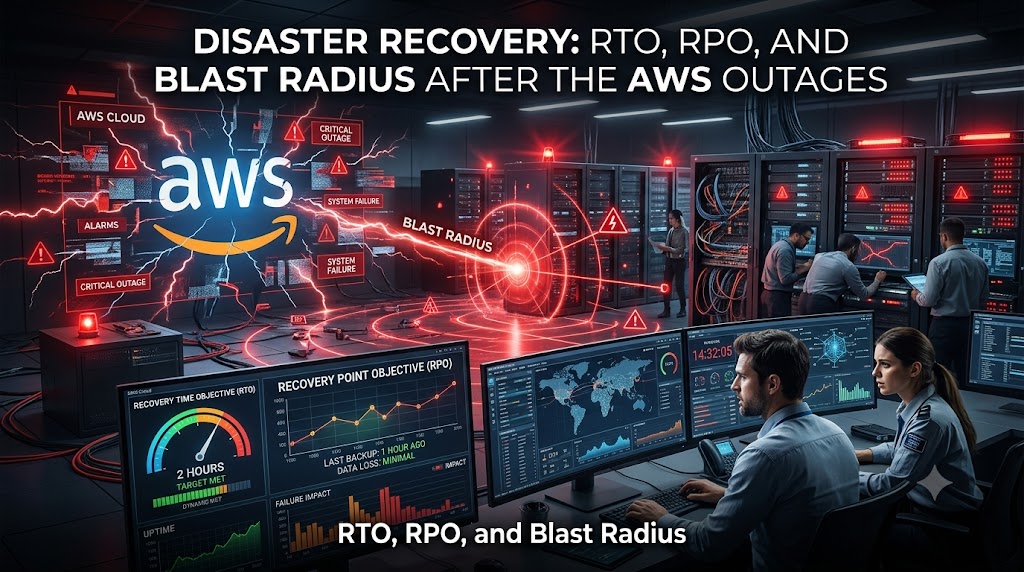
- October 20, 2025 — AWS us-east-1 began as a DNS fault: a race condition in DynamoDB's automated DNS management left an endpoint record empty, cascading through EC2, NLB, and Lambda for roughly 15 hours and taking down Snapchat, Reddit, Fortnite, and Coinbase (AWS post-event summary).
- November 18, 2025 — Cloudflare went down for about six hours from an internal bug (a database permissions change bloated a Bot Management feature file), affecting roughly one in five web pages, including X, ChatGPT, and Spotify. It was not caused by AWS (Cloudflare).
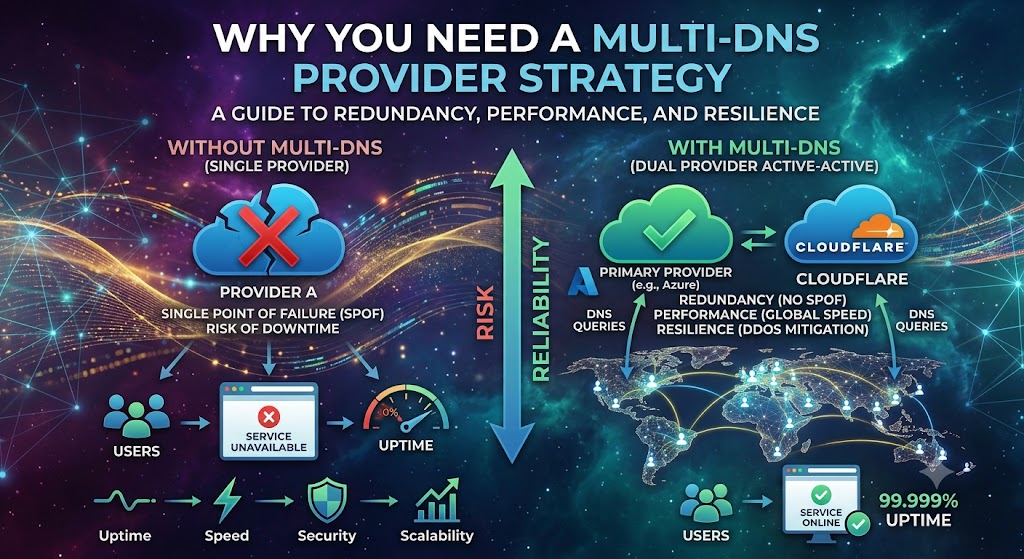
- A multi-DNS strategy removes that single point. Running your zone across two independent authoritative providers means one can fail entirely and resolution continues.
What actually happened in 2025
Two of the year's largest outages were, at their root, name-resolution stories — and they are frequently conflated, so it's worth separating them.
October 20: a DNS fault took down half the internet
Per AWS's own post-event summary, the trigger was a latent race condition in DynamoDB's automated DNS management in us-east-1. A slow update process applied a stale plan and overwrote the DNS record for the regional DynamoDB endpoint with an empty set. dynamodb.us-east-1.amazonaws.com stopped resolving — and because AWS's own control plane leans on DynamoDB, the failure cascaded into EC2 launches, Network Load Balancer health checks, Lambda, and Route 53. The disruption ran roughly 15 hours and pulled Snapchat, Reddit, Fortnite, Coinbase, Venmo, and Signal offline worldwide from one region's fault (ThousandEyes).
November 18: a DNS provider itself went dark
A month later, Cloudflare — which provides authoritative DNS for millions of domains — suffered its own unrelated failure. A change to database permissions on a ClickHouse cluster caused a query to emit duplicate rows into a "feature file" used by Bot Management, doubling its size and crashing the systems that load it (Cloudflare, Nov 18 2025). At the peak, roughly one in five web pages and about a third of the world's 10,000 most popular sites were affected, including X, ChatGPT, Spotify, and Canva, before full restoration around 17:06 UTC. Cloudflare confirmed it was not a cyberattack.
The two events had nothing in common technically. But together they bracket the exact risk a multi-DNS strategy addresses: DNS can fail as an infrastructure layer (October), and the company running your DNS can fail as a whole (November). If your names only resolve through one of them, either failure is a total outage for you.
Why DNS is a single point of failure
DNS feels invisible because it works ~100% of the time, which is exactly why it gets under-engineered. Every name in your zone (the A/AAAA records for your API, the CNAMEs for your CDN, the MX records for mail) is served by a set of authoritative nameservers. If you use one managed DNS provider, all of those nameservers belong to that one company. Their control-plane bug, expired certificate, BGP withdrawal, or billing lockout takes every one of your names offline at once.
This isn't hypothetical or rare — it's the default. Research on the top 100 retail domains found that 65% were at risk of a single-provider DNS outage (DNS Made Easy). A broader academic survey of global sites found that only about 4% used multiple third-party DNS providers (Third-party Service Dependencies and Centralization Around the World). The overwhelming majority of the internet is one provider incident away from being unreachable.
And the meter runs fast. ITIC's 2025 survey put the median cost of downtime at $9,000 per minute — about $540,000 per hour — for enterprises with 1,000+ employees (ITIC 2025, via OutageCost). Apply that to even a two-hour resolution failure and the math for a second DNS provider stops being a hard sell.
What a multi-DNS strategy actually is
A multi-DNS strategy means your zone is authoritatively served by two independent providers at the same time, so a query for your domain can be answered even if one provider is completely down. There are two common shapes:
- Primary / secondary (hidden primary + AXFR). One provider is the source of truth; the second pulls the zone via standard zone transfer (AXFR/IXFR). Both are listed as authoritative at the registrar. Simple, standards-based, and the second provider stays automatically in sync.
- Primary / primary (dual active). You push records to both providers independently via their APIs. More operational work and you must keep the two in sync yourself, but you avoid depending on one provider's transfer mechanism and you can use provider-specific features (like different health-checked failover) on each.
In both cases the registrar's NS records point at nameservers from both providers. Resolvers try them and use whichever answers — so if one provider's entire fleet is unreachable, the other still resolves your names.
The tradeoffs: when it's worth it
A second DNS provider is not free, and not every project needs one. The honest costs:
- Money. A second managed DNS plan, typically billed on queries or zones. For most services this is a rounding error next to one hour of downtime; for a hobby project it may not be.
- Sync complexity. Records must stay identical across both providers. AXFR handles this automatically; a dual-primary setup needs automation (Terraform, octoDNS) so a change in one place lands in both.
- DNSSEC. This is the sharp edge. Multi-provider DNSSEC requires either a shared signing key across providers or multi-signer (RFC 8901) support. Not all providers offer it, and getting it wrong breaks resolution worse than a single-provider outage would. If you run DNSSEC, confirm multi-signer support before committing.
- Feature parity. Provider-specific features (geo-routing, weighted failover, proxied records like Cloudflare's orange-cloud) may not translate to the second provider. Records that must be portable have to stay standards-based.
The rule of thumb: if a resolution outage costs you real money, reputation, or safety, run two providers. If you're serving a personal site, a single reputable provider is a reasonable bet. The 2025 outages are the argument for everyone in between.
How to implement it
The primary/secondary model is the lowest-friction way in. A practical path:
- Pick two independent providers. Independence is the whole point — avoid two brands on the same underlying network. Common pairings: Route 53 + Cloudflare, NS1 + Dyn, Google Cloud DNS + a specialist like DNS Made Easy.
- Designate a primary and enable zone transfer. Configure AXFR/IXFR on the primary and add the secondary's transfer IPs to the allow-list. Use a TSIG key to authenticate transfers.
- Add the secondary as authoritative at your registrar. List nameservers from both providers in the domain's NS records. This is the step that actually delivers the redundancy — skip it and you just have a warm spare nobody queries.
- Handle DNSSEC deliberately. Either disable it, or use a multi-signer (RFC 8901) configuration that both providers support. Do not half-configure it.
- Monitor both providers independently. Query each provider's nameservers directly (not just your public domain) so you detect one going stale or falling out of sync before it matters. Alert on record drift between the two.
- Automate record changes. For dual-primary, manage records as code with something like octoDNS or Terraform so every change is applied to both providers atomically.
IBM Technology's overview covers how primary and secondary DNS work together, including zone transfers:
Frequently asked questions
Isn't one big DNS provider already redundant?
Within itself, yes — providers run anycast fleets across many locations. But that redundancy shares a control plane, a codebase, and a company. The November 18 Cloudflare outage and the October 20 AWS DNS fault both hit providers with enormous internal redundancy; the failures were global to the provider anyway. Independent providers fail independently, which is the property you actually want.
Does a multi-DNS setup slow down resolution?
No meaningfully. Resolvers cache aggressively and pick the fastest-responding authoritative nameserver, so adding a second provider generally has no negative latency impact and can improve resilience against regional slowness.
What about DNSSEC across two providers?
It's the one part that needs care. Standard single-signer DNSSEC assumes one signing authority; running it across two providers requires a shared key or the multi-signer model in RFC 8901. Confirm both providers support it before enabling, or run without DNSSEC until they do.
Conclusion
The 2025 outages weren't freak events — they were the predictable outcome of concentrating name resolution in one place. October showed DNS failing as a layer; November showed a DNS provider failing as a company. A multi-DNS strategy answers both by making sure no single provider's worst day can make your names unresolvable.
- Treat DNS as a first-class dependency, not plumbing you configure once and forget.
- Run your zone across two independent authoritative providers — primary/secondary via AXFR is the easy start.
- List both providers' nameservers at the registrar, mind DNSSEC, and monitor the two independently.
The cost of a second provider is small and predictable. The cost of discovering you only had one is a headline you don't want to be in.
Need infrastructure work like this done right? See what I do or look at recent builds.